
What Is Uterine Cancer?
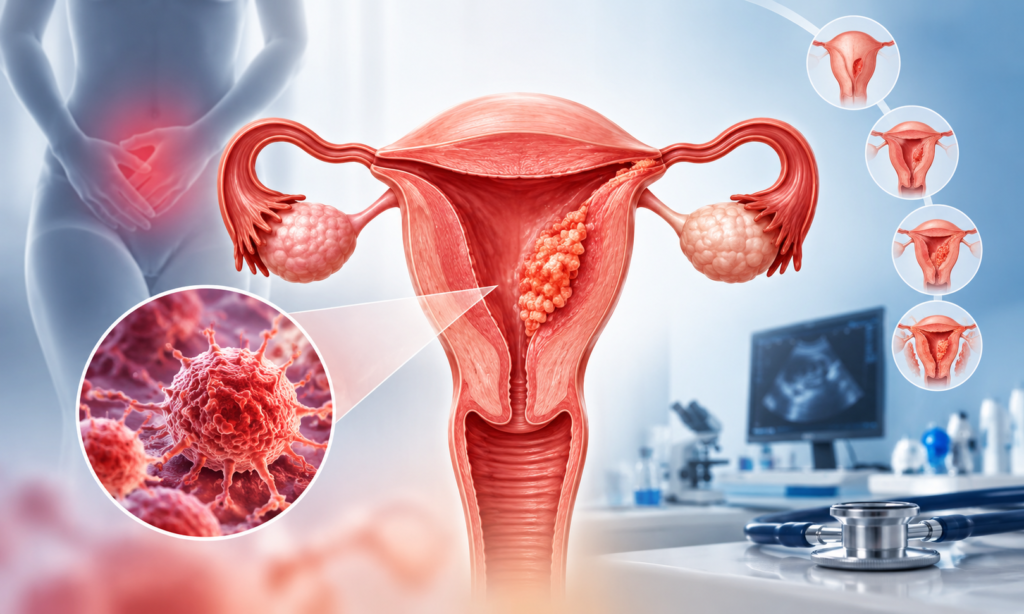
In simple words, uterine cancer denotes a cancer that starts in the uterus – the hollow, pear-shaped organ where the baby grows during pregnancy.
What Are the Symptoms of Uterine Cancer?
Abnormal vaginal bleeding is the most notable and common symptom of uterine cancer. This includes:
- Postmenopausal bleeding – Any vaginal bleeding or spotting after menopause
- Unusually heavy periods – Extended periods, frequently occurring periods, or periods characterised by a high discharge volume
- Inter-period spotting – Unexpected spotting or bleeding between two normal menstrual cycles
Apart from the different types of vaginal bleeding, lower abdominal pain and clear vaginal discharge in postmenopausal women are also potent warning signs to watch out for.
How Is Uterine Cancer Diagnosed?
The following tests are conducted to detect uterine cancer:
- Pelvic Examination – This is a basic clinical process – a visual inspection – where the doctor checks the vulva and further examines the vagina and cervix using a speculum. However, a pelvic exam alone is not sufficient for conclusively diagnosing uterine cancer.
- Transvaginal Ultrasound (TVUS) – It’s a relatively quick, painless imaging procedure that enables the healthcare team to view and check a woman’s pelvic organs in superior detail, including the uterus, ovaries, fallopian tubes, and cervix.
- Endometrial Biopsy – An endometrial biopsy is a quick in-clinic test where the doctor collects a small sample of tissue from the uterine lining, which is then examined by a pathologist for cancerous cells.
- Hysteroscopy – It is a test that allows the doctor to see inside the patient’s uterus. The procedure entails passing a thin, flexible tube with a camera at the end (hysteroscope) into the uterus through the vagina. If suspicious spots are found, a biopsy is taken, and the tissue is then microscopically examined in the lab.
What Are the Different Stages of Uterine Cancer?
The FIGO System classifies the progression of uterine cancer into four distinct stages as described below:
Stage I: Cancer that is confined to the uterus.
Stage II: Cancer that has spread to the cervix.
Stage III: Cancer that has spread to the vagina, ovaries, and/or lymph nodes.
Stage IV: Cancer that has spread to the urinary bladder, rectum, or organs located far from the uterus, such as the lungs or bones.
Apart from the main stages, there are also sub stages that indicate the spread of the disease and damage afflicted on specific organs.
How Is Uterine Cancer Treated?
There are several approaches to treat uterine cancer, including surgery, chemotherapy, and/or radiation. The doctor decides on a particular procedure or combination of treatments depending on several factors, including the patient’s age, cancer progression, etc.
Surgery: Called total hysterectomy, this surgery involves removing the uterus and cervix. It is usually followed by removal of the fallopian tubes and ovaries, called a salpingo-oophorectomy. It can be performed in several ways, viz vaginal hysterectomy, vaginal laparoscopic hysterectomy, abdominal laparoscopic hysterectomy, and abdominal hysterectomy.
Radiation Therapy: In this procedure, high-energy rays are used to kill cancer cells. This treatment can be of two types – internal radiation (vaginal brachytherapy) and external radiation (external beam radiation therapy).
Since radiation therapy can shrink a tumour and make it easier to remove, it is sometimes recommended before surgery.
Chemotherapy: Here, strong medicines, usually administered through an IV, kill cancer cells. In some cases, oral pills are also recommended.
Hormone Therapy: This involves giving the patient medications that slow cancer growth; this is usually advised for early-stage patients.
Immunotherapy: Here, certain speciality drugs help the immune system recognise, attack, and destroy specific cancer cells.
Why Early Detection and Regular Medical Evaluation Matter?
Uterine cancer, especially in its advanced stages, has the potential to damage a woman’s entire reproductive system.
Early detection, together with regular medical assessment, plays an instrumental role in the successful treatment of uterine cancer. It helps avoid a lot of trauma and stress later.
FAQs
What is the earliest stage of uterine cancer?
This is the stage where the tumor is strictly confined to the uterus.
Is Stage I uterine cancer curable?
Yes, it is curable, and is characterized by high cure and survival rates.
What is the most common first symptom of uterine cancer?
Abnormal vaginal bleeding, which occurs in roughly 90% of cases, is the most common first symptom of uterine cancer.
Can uterine cancer spread to the ovaries?
Yes, it can.
Does uterine cancer always require surgery?
No, uterine cancer does not always require surgery. The doctor decides about the mode of treatment after studying the patient’s health condition and several other factors.
What is Stage IV uterine cancer?
It means the disease has spread outside the uterus into nearby pelvic organs or distant parts of the body.
